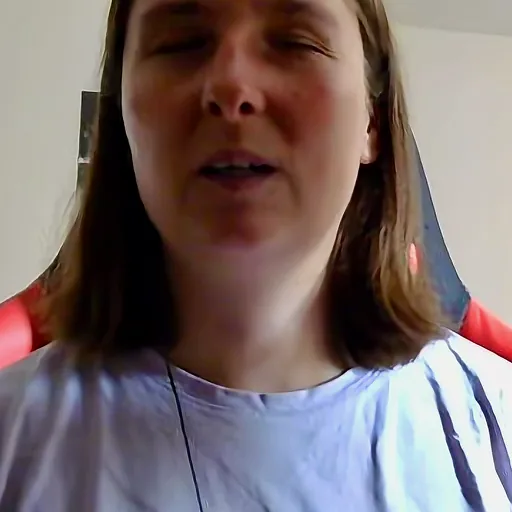
Melanie Fleischmann on Blind Approvals in Frazier
And I can choose for myself when to do the approval.
Hello Melanie, please introduce yourself briefly!
I am 33, live in Munich, and am blind. Originally, I trained as a social pedagogue, became self-employed as a speech-to-text interpreter in 2020, and realized as early as 2021/22 that AI was increasingly cutting into my business in that field. In 2022, I attended the audio description workshop with Bernd Benecke from BR because I found it exciting that blind and sighted people collaborate there.
That’s where I met Janna, now a very close colleague, who asked me if I would like to work for Descriptive Video Works. I’ve been doing that since 2022. Since this year, I have also been working for D-Facto Motion, Bewegte Bilder, and from time to time, writers also contact me privately.
How did you find your way to Frazier?
During the first workshop with Bernd, I was still working in the traditional way with Word and VLC. Even then, we realized, wow, it’s crazy how long that takes. First you have to write down the timecode, then your text, and then you have to play the video and speak the text to see if it fits. Then, in a second workshop, Janna and I started working with Frazier and realized we got much more done than all the other participants.
Since a few things weren’t working quite right yet, I simply wrote to you. You fixed the bugs, and for the past one or two years, it has worked so well that I can work normally and also handle the approval process.
How does a typical project work for you today?
A client contacts me: the film arrives tomorrow and has to be out by Friday. I am then invited to their Frazier project. I watch the film and leave comments at the points where I have something to say or ask. Afterward, I review everything from top to bottom. When I’m done, I let them know, the team takes the film back, and sometimes we briefly clarify individual comments. But usually, these are things that are simply changed without us needing to discuss them again.
What is your favorite feature in Frazier?
Clearly, the comments. They allow you to communicate. That’s also what people who don’t understand the system always criticize. They say, “Well, then you can’t talk to people.” Yes, I can. Not in a direct, one-on-one conversation, but I can write a comment.
And it’s just like writing a WhatsApp message. Except it’s directly at the right spot, and the other person can see exactly what I’m referring to without us having to painstakingly search for the correct timecode again. Compared to a direct conversation, this saves a huge amount of time in communication.
How much effort does it take to get started with Frazier?
I once had an older writer in a training session who described herself as not tech-savvy at all. She kept emphasizing how terrible it was going to be. But it wasn’t bad at all because I was able to explain it to her well. I only showed her how to start the video and add comments without changing the text herself. Within an hour and a half, she had fully grasped it.
Group training sessions, on the other hand, take longer because different levels of knowledge and often two different working environments (Mac and Windows) come together. If someone is generally proficient with computers, one hour of one-on-one training is now sufficient for me.
Was there a particular “aha!” moment for you?
Actually, it surprises me every time how quickly I get back into it. Even if I haven’t had a project for months. I don’t have to get used to it again; it’s like riding a bike. And compared to traditional tandem work, where you have to schedule a meeting with a sighted person and go through the film synchronously, it makes a huge difference that I can decide for myself when to work. Even if it’s at two in the morning, after the film has finished.
So, there’s no going back to the traditional workflow?
Absolutely not. The time savings alone make a huge difference, but above all, I wouldn’t want to give up that independence anymore.